


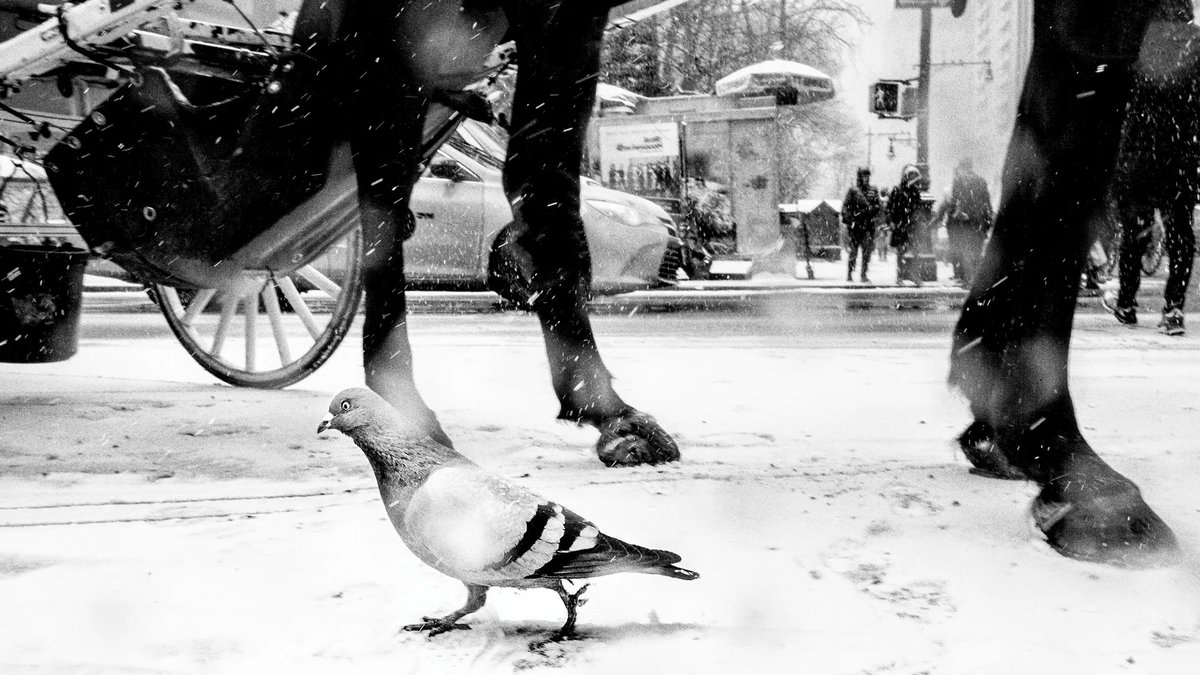
Alan Schaller’s latest photography book, Street Safari, is a collection of images featuring cats, dogs, pigeons, foxes, elephants, and other creatures that have wandered into his frame over the past decade. The book is not just about animals, but about observation and finding extraordinary moments in everyday life.
Schaller’s approach to photography is unique, and he has built an international reputation for his distinctive black and white images. He doesn’t manufacture meaning after the fact, instead, he lets the images speak for themselves.
Schaller’s gift is recognizing that the world is already strange, funny, and quietly remarkable if you’re willing to look closely enough. He says, “I wish I could tell you there was some profound concept behind it, but honestly, there wasn’t.” This approach makes him one of the most distinctive voices in contemporary street photography.
When traveling through parts of the Middle East and other countries, Schaller discovered that asking to photograph somebody’s cat or dog was an unexpectedly effective icebreaker. “People are incredibly proud of their animals,” he explains. This observation says as much about people as it does about photography, and it highlights the importance of animals in focus through the lens.
Animals become a kind of social lubricant, making the camera feel less like an intrusion and more like an invitation into someone else’s world. However, they also make terrible collaborators, as they have absolutely no interest in helping photographers.
Schaller’s point is that a famous face or striking model arrives carrying visual interest before the shutter is even pressed, but a pigeon offers no such advantage. If the photograph works, it’s because the photographer found something everyone else overlooked. For Schaller, that’s the essence of street photography.
A shaft of light transforms a commuter into theatre, and a mouse crossing an empty London street becomes mythological. Schaller’s visual language barely changes, whether he’s photographing a luxury watch, a commuter, or a cat disappearing down a Roman alleyway.
He says, “I shoot the way I shoot,” and the subject is almost incidental, with light doing the heavy lifting and composition creating the tension. Schaller has surprisingly strong feelings about equipment, and he believes that photography has developed an unfortunate tendency to confuse tools with talent.
Cameras have become status symbols, and social media is littered with debates over dynamic range, autofocus algorithms, and megapixels. He says, “If you can’t make a good photograph with almost any modern camera, the problem probably isn’t the camera.”
Technical knowledge has never been more accessible, and exposure, composition, and post-production can all be learned from books, YouTube, or sheer persistence. What can’t be downloaded is judgment, and that only comes from walking the streets, making mistakes, and learning, frame by frame, what deserves your attention, much like finding the perfect locations for stunning photography.
Street Safari feels refreshing because it rejects the increasingly common idea that creativity must always be accompanied by complexity. Sometimes the work is simply the work, and the challenge isn’t to explain the world, but to pay enough attention to notice it, much like the way lab-created gems can bring balance to love.
The animals in the book are never reduced to symbols or sentimentalized into characters; they exist on their own terms, sharing the same streets and the same light as the people Schaller has spent years photographing. The photographs never insist on what you should think or feel, but instead, they slow you down just long enough to notice what was there all along.
In an age obsessed with spectacle, this is a quietly radical idea. Extraordinary photographs rarely require extraordinary subjects; they require extraordinary attention. Schaller seems content to wait until ordinary subjects become remarkable, and that’s what makes his book so unique.
Street Safari is published by Irys Publishing and is available to buy now, with a recommended retail price of £75.


