


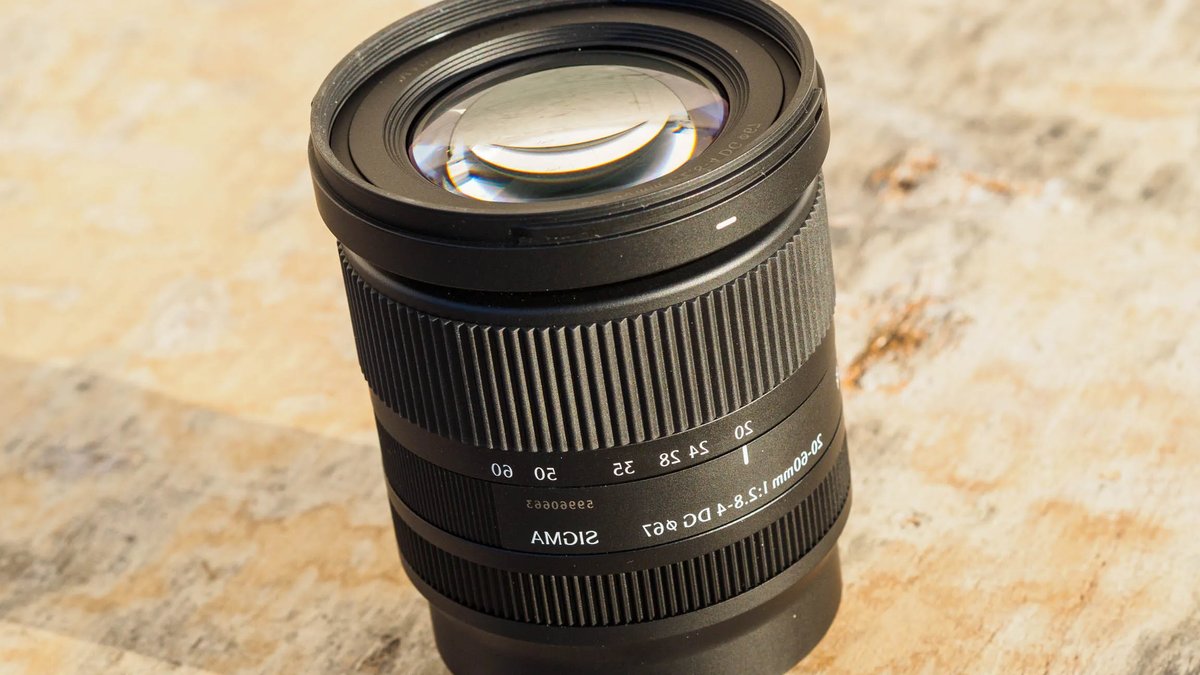
Sigma’s latest lens, the Sigma 20-60mm F2.8-4 DG | Contemporary, is a standard zoom for full-frame cameras that combines an unusually wide-angle view and large aperture in a remarkably small size. This lens is designed for everyday photography, with an emphasis on genres that will benefit from its ultra-wide view, such as cityscapes, and travel.
The Sigma 20-60mm F2.8-4 DG is available in L-mount and Sony E versions for $849 / £749. It’s similar in size and weight to the Tamron 20-40mm F/2.8 Di III VXD and Panasonic’s Lumix S 20-60mm F3.5-5.6, but offers the best balance of zoom range and aperture of the three.
Design and Build
The lens has a petite dimension, making it especially attractive to photographers using smaller full-frame cameras such as the Sigma BF, Panasonic Lumix S9, and Sony Alpha A7C / A7C II / A7CR range. The outer barrel is constructed of plastic and feels perfectly robust, with dust-and-splash resistant construction.
There are just two controls, the zoom ring at the front and the focus ring closer to the camera. The manual focus ring operates electronically and is very smooth and nicely damped.
Autofocus and Image Quality
The lens employs Sigma’s HLA (High-response Linear Actuator) system, which drives a single lens element back and forth internally, promising fast, quiet autofocus. Focus breathing is suppressed optically.
When it comes to image quality, the Sigma 20-60mm F2.8-4 punches well above its weight. Images look clean with plenty of fine detail, even when tested on the 60MP Sony A7R V. The lens can’t quite match top-end lenses such as 24-70mm f/2.8s for absolute pixel-level sharpness under all conditions, but the differences are only obvious when staring closely onscreen or printing images really large.
Read Also: Legacy of a photography pioneer still inspires
The lens has some optical weaknesses, such as visible blurring in the corners wide open at the wide-angle end, but this cleans up well on stopping down. It also occasionally shows some softness slight wide open, particularly at longer focal lengths and close focus distances.
Additionally, the lens’s ability to produce a near-circular aperture, thanks to its 9 curved blades, helps to deliver attractive bokeh, making it suitable for capturing portraits and other subjects where a pleasing background blur is desired. The maximum aperture decreases as you zoom in, from f/2.8 at 20mm to f/4 at 40mm, is a compromise that allows for the lens’s compact size and lightweight design.
Conclusion of Testing
Overall, the Sigma 20-60mm F2.8-4 DG is a really nice little lens that does what it’s supposed to do with little fuss. It’s small and easy to carry, focuses quickly and accurately, and delivers very respectable image quality. The lens is dependent on software corrections for distortion and vignetting, but this is inevitable to achieve this specification in such a small size.
For full-frame users in search of a lightweight standard zoom, the Sigma 20-60mm F2.8-4 DG is a standout choice that offers something a bit different to the alternatives. It could be particularly popular as an everyday zoom for travel photography, pairing up nicely with a relatively small telezoom such as the Tamron 50-300mm F/4.5-6.3 Di III VC VXD to give a lightweight kit with plenty of zoom range.
In comparison to similar situations, the Sigma 20-60mm F2.8-4 DG seems to have found a good balance between size, weight, and image quality. Its ability to deliver high-quality images in a compact package makes it an attractive option for photographers who want a versatile lens without the bulk.
The Sigma 20-60mm F2.8-4 DG is a great option for those looking for a lightweight and compact standard zoom lens. With its impressive image quality, fast and quiet autofocus, and compact design, it’s an excellent choice for everyday photography, travel, and video applications.


